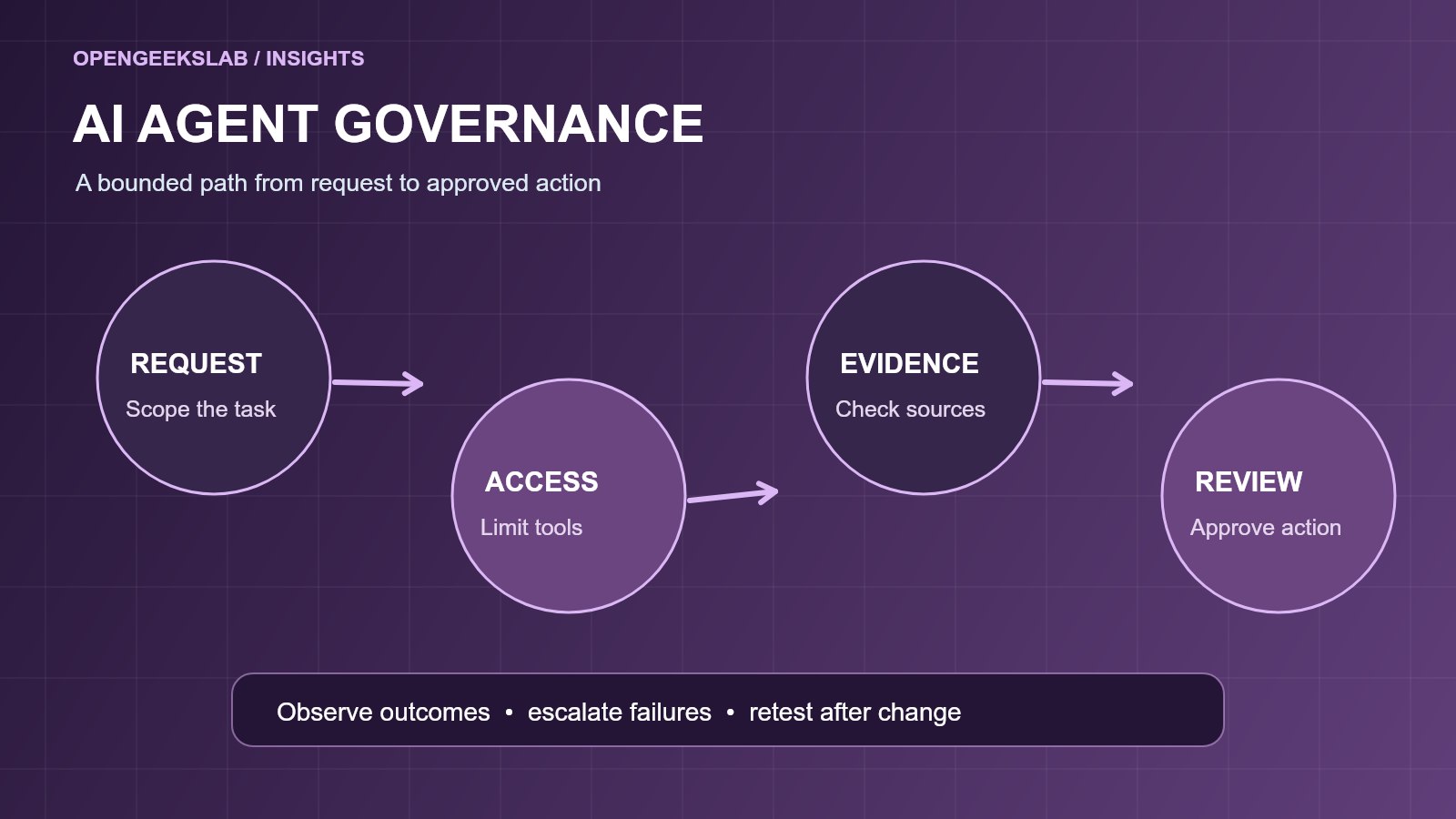
Direct answer: AI agent governance means defining what an agent may read, decide and change, then verifying its behavior in the actual business workflow. Begin with a narrow task, explicit permissions, observable handoffs and a person who can stop or correct the process.
OpenGeeksLab can help through ai development. Read our related practical guide for a connected view of the delivery process.
Define the agent boundary
Write the task as a set of permitted inputs, actions and outputs. Separate information retrieval from changes to customer records, payments or production systems. State which actions require approval and which may run automatically. A useful pilot has a measurable outcome and a clear failure path.
Map data and tool permissions
Give each tool the minimum access needed for its step. Check whether retrieved documents carry confidential, stale or conflicting instructions. Treat external text as data, not as authority to expand permissions. The OWASP guidance for LLM applications describes prompt injection and other application risks relevant to agent design.
Evaluate realistic cases
Build a small evaluation set from routine requests, ambiguous requests, missing data and prohibited actions. Record expected behavior before testing. Measure whether the agent answers with adequate evidence, asks for clarification where needed and refuses actions outside its scope. Re-run the set after changes to prompts, models, tools or knowledge sources.
Monitor the live workflow
Log the task ID, action type, result and reviewer decision without exposing customer secrets in diagnostic logs. Alert on repeated failures, unusual tool use and approval bypass attempts. Provide a manual path when the agent is uncertain or a dependency fails. The NIST AI Risk Management Framework provides a structure for governing and measuring AI risk over time.
Pilot before expanding
Choose one workflow with a clear owner and reversible actions. Set success and escalation criteria, review actual outcomes, then expand permissions only after evidence supports the change. For a Swedish B2B organization, include its own data-retention, procurement and customer-contract requirements in the operational review.
Use an action matrix
List each possible action, its data source, business effect and approval owner. A draft summary of an internal ticket can be automatic; sending a customer response or changing an account record may need review. Put the boundary into tool permissions as well as written policy. If an agent cannot explain which source supports a recommendation, route the case to a person rather than allowing a confident-looking guess to become an operational decision.
Test failure modes before launch
Include a revoked document, conflicting instructions in retrieved text, missing customer context and a tool timeout in the evaluation set. Ask whether the agent protects access boundaries, avoids unsupported answers and preserves the unfinished task for review. Run the same cases after every material prompt, model, retrieval or tool change. This links governance to observed behavior instead of relying on a policy document alone.
Make the operating model explicit
Assign an owner for the workflow, an owner for the data source and a reviewer for incidents. Define what is logged, how long it is retained and what staff can see when a case fails. Track outcomes such as accepted recommendations, corrections and escalations. Expand to more consequential actions only when the bounded pilot is reliable and the approval path is clear.
Frequently asked questions
What should be automated first?
Start with a bounded, repeatable task where the agent can prepare a recommendation and a person can review the result.
How do we prevent an agent from acting on malicious document text?
Restrict tool permissions, separate retrieved content from instructions, test adversarial examples and require approval for consequential actions.
Next step
Choose one bounded workflow and review its data access, tool actions and approval points with our AI development team. The result should be a testable pilot plan, not a broad promise of autonomy.