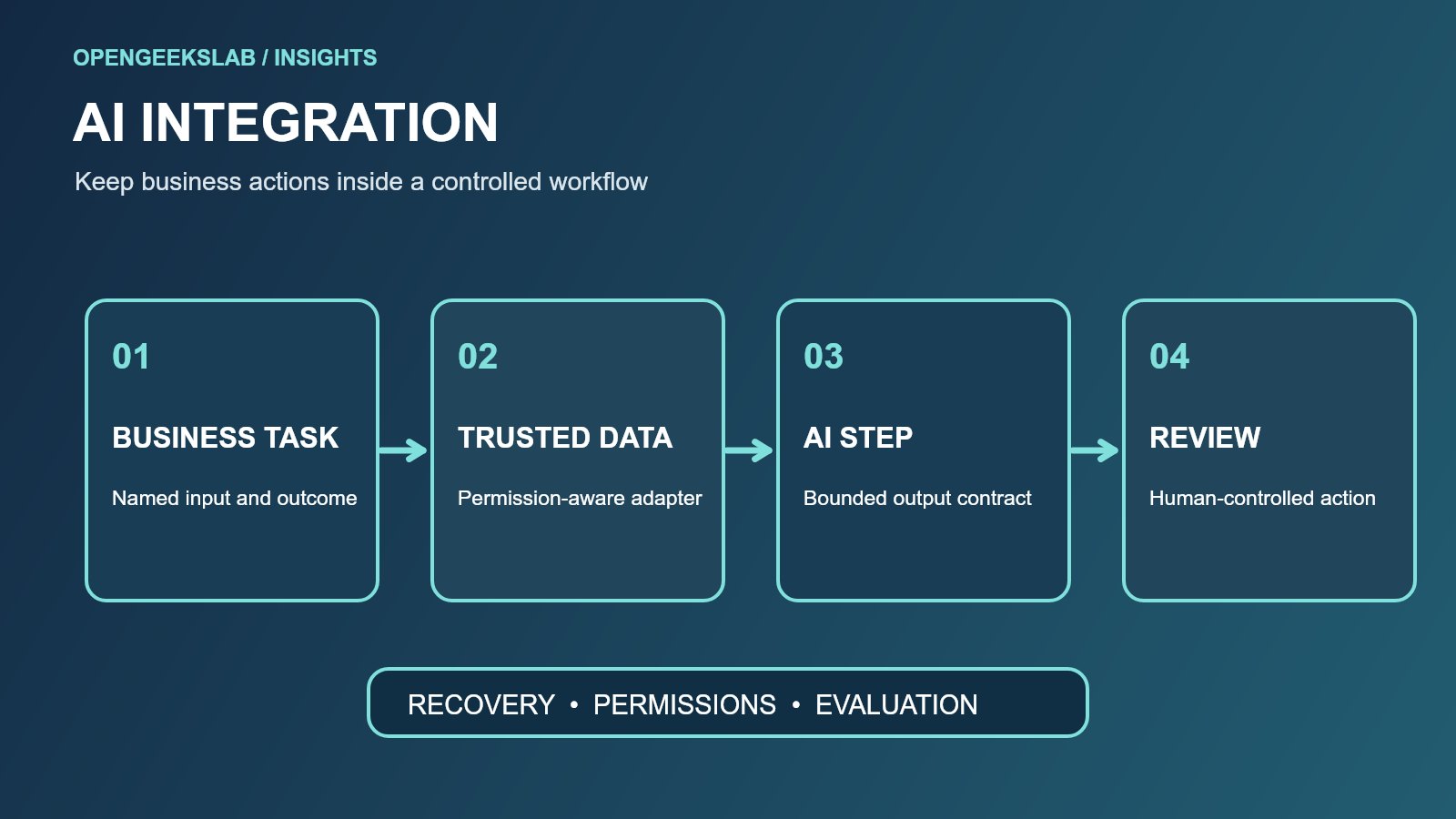
Direct answer: Integrate AI with one business workflow at a time. Define the task, the data the system may use, the decision a person must retain, and the evidence that the integration improves work. A model call alone is not an integration; the surrounding permissions, recovery path and operating owner determine whether it can be used safely.
For a Swedish B2B team, the starting point is often an existing CRM, ticket system or operations platform. Before selecting a model, map one real case from request to verified outcome. OpenGeeksLab’s AI development service covers the product path; our AI agent governance guide explains control responsibilities when software can take action.
Choose a bounded job
Pick a task whose input and expected output can be reviewed: summarizing an incoming support case, classifying a document for a queue, or drafting a response for an account manager. Record the current time, error types and escalation points. Avoid starting with a vague instruction to automate an entire department. A bounded job gives the team a way to compare the new workflow with the old one.
Write a contract for the AI step: accepted input, output format, prohibited content, timeout and fallback. If the output is a draft, label it as a draft in the interface. If an action changes a customer record, identify the approval step and the person accountable for it.
Put data access before prompt design
Determine which system owns each field and what a user is allowed to see. Pass only the data needed for the task. A retrieval layer must apply the same permissions as the source system; a model must not become a shortcut around role-based access. Treat customer messages and retrieved documents as untrusted input, including instructions embedded inside them.
The OWASP guidance for LLM applications describes risks including prompt injection and sensitive information disclosure. Translate those risks into tests using representative records and deliberately adversarial input. Record the data retention and access decisions before connecting production records.
Design the integration as a recoverable transaction
Separate read operations from writes. For each write, give the operation a stable identifier so a retry after a timeout cannot create a duplicate ticket or customer message. Make status visible: queued, awaiting review, completed or failed. Keep the original record and the proposed AI output available for an authorized reviewer.
A simple architecture has four boundaries: the business application, a permission-aware data adapter, the AI service, and the approval or execution layer. Log operational identifiers, timings and decision outcomes without recording unnecessary customer content. A failure in the model service should return work to a human queue rather than silently dropping it.
Evaluate before widening scope
Build a test set from real task types with sensitive details removed. Include ordinary cases, incomplete records, conflicting instructions, unsupported requests and exceptions. Score usefulness, factual accuracy, policy compliance and the amount of human correction needed. The NIST AI Risk Management Framework provides a structure for mapping, measuring and managing AI risk; use it to assign owners and controls, not as a substitute for task-level evaluation.
Release to a small group first. Monitor how often people accept, correct, reject or escalate the output, and inspect failures by case type. Expand only when the team can show both an improved outcome and a dependable recovery process.
A decision checklist for the first release
- One named task and a measurable baseline.
- Documented source systems, permissions and retention.
- A review boundary for consequential actions.
- Repeat-safe writes and visible failure states.
- An evaluation set and a named operational owner.
Bring the workflow map and sample cases to a discovery conversation. We can help define a controlled integration that proves value before it reaches more systems.
Frequently asked questions
Does an AI integration need an autonomous agent?
No. Many useful systems classify, summarize or draft while a person decides what happens next. Autonomy should follow demonstrated reliability and explicit authority.
What should happen when the AI service is unavailable?
Keep the original task in a visible queue, show the failure to the responsible team, and let the existing manual process continue.