Direct answer: A software handover is complete when the receiving team can change, deploy, monitor and recover the product without relying on undocumented knowledge. Ask for access ownership, an architecture map, a tested release process, operational runbooks and a clear list of open risks.
For a business owner, the key question is whether the product can keep serving customers after the original delivery team steps away. OpenGeeksLab’s custom software service includes engineering ownership across delivery. Our API integration design guide covers one area that often needs particularly clear handover.
Confirm ownership and access
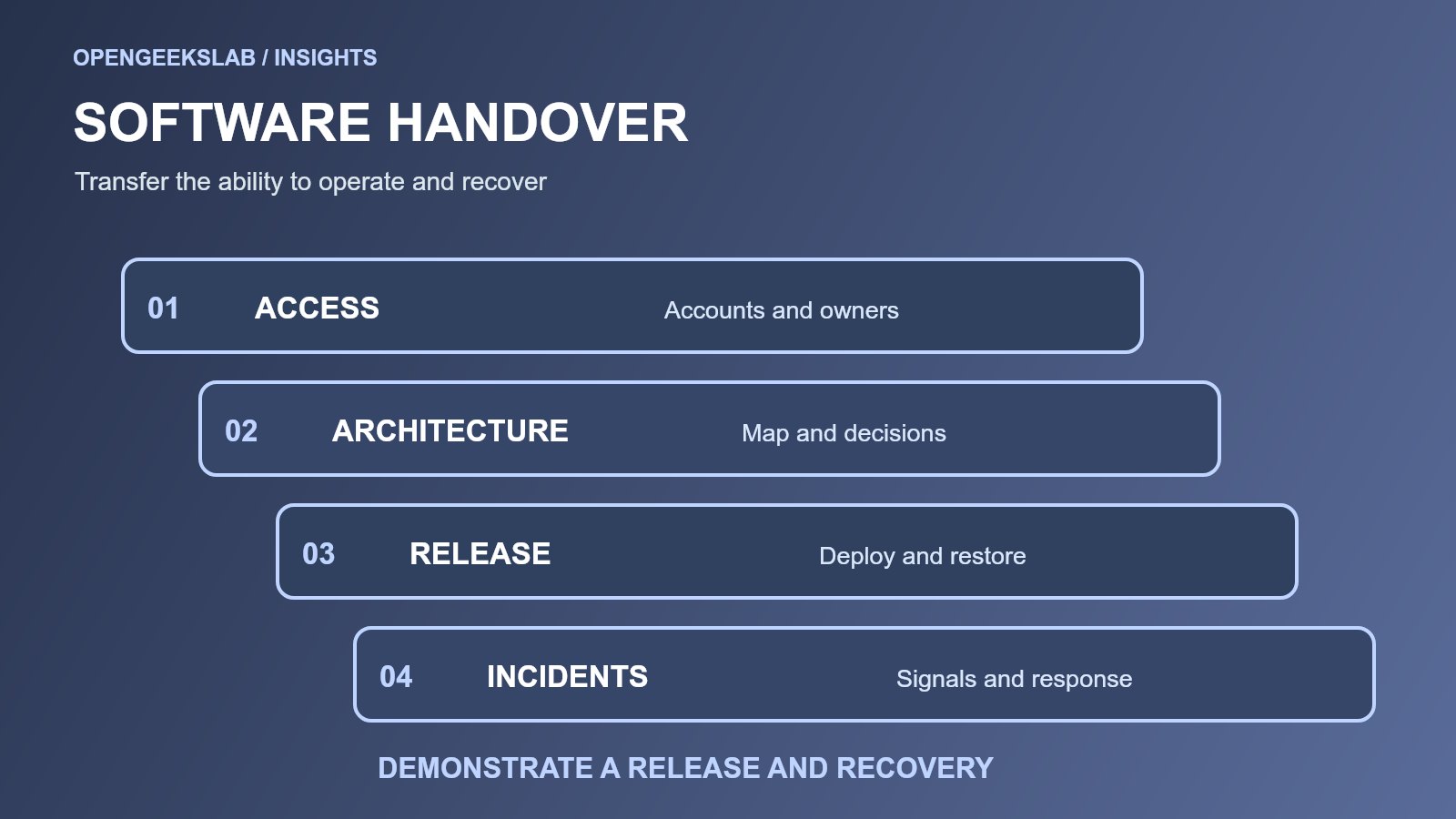
List the accounts and services the product depends on: source repository, hosting, domain, deployment pipeline, database, monitoring, analytics and third-party APIs. For each, name the legal owner, operational owner, billing owner and backup contact. Transfer access through approved account processes rather than sharing a personal password.
Review service accounts, API keys and renewal dates. Verify that the receiving team can rotate credentials and revoke departing users. Record the least privilege needed for routine maintenance and the emergency access process. A handover document that only lists URLs does not establish operational control.
Make the architecture understandable
Provide a short system map showing user-facing components, data stores, integrations and the path of a typical request. Identify the authoritative record for each business entity and the most important failure boundaries. Document decisions that might otherwise look accidental: why a queue exists, why a field is cached, or why a legacy endpoint remains.
For each integration, record contracts, authentication, rate limits, retries, idempotency and support contacts. Point to the deployed version and the source revision that produced it. Keep the explanation concise enough that an engineer unfamiliar with the project can follow a customer issue from report to root cause.
Prove a release and a recovery
The receiving team should perform a controlled deployment in a non-production environment, then rehearse the approved production release path. Record how to test, approve, roll back or roll forward, and verify the result. Backups matter only if restoration has been tested; include the location, frequency, access owner and last successful restore exercise.
The NIST Secure Software Development Framework describes practices for producing and maintaining secure software. Use it to review build, change and vulnerability-handling responsibilities. The OWASP Application Security Verification Standard can help define repeatable application security checks for future releases.
Prepare incident and support runbooks
Document what alerts exist, what a healthy service looks like and which symptoms need immediate response. Include log and dashboard locations, customer communication ownership and escalation contacts. For common failures, record safe first checks and actions. Avoid copying sensitive data into the runbook or incident reports.
Agree on support hours, response expectations and the boundary between defect fixes and new features. Record unresolved defects with impact, workaround and owner. Handover is a transition of responsibility, so schedule a period where the outgoing team can answer questions while the receiving team leads the work.
Acceptance checklist
- Named owners can access and administer every critical service.
- Architecture and data ownership are documented.
- The receiving team has deployed and restored in a safe environment.
- Monitoring, incident response and support contacts are usable.
- Open risks and future work have explicit owners.
Ask the receiving team to demonstrate these capabilities. A signed document is useful, but an observed release and recovery provide stronger evidence that the product can be maintained.
Frequently asked questions
Is source code enough for a handover?
No. The team also needs access, architecture context, deployment steps, tests, operational signals and recovery procedures.
Who should accept the handover?
The business owner and the people who will operate the product should both accept it after a practical walkthrough.