
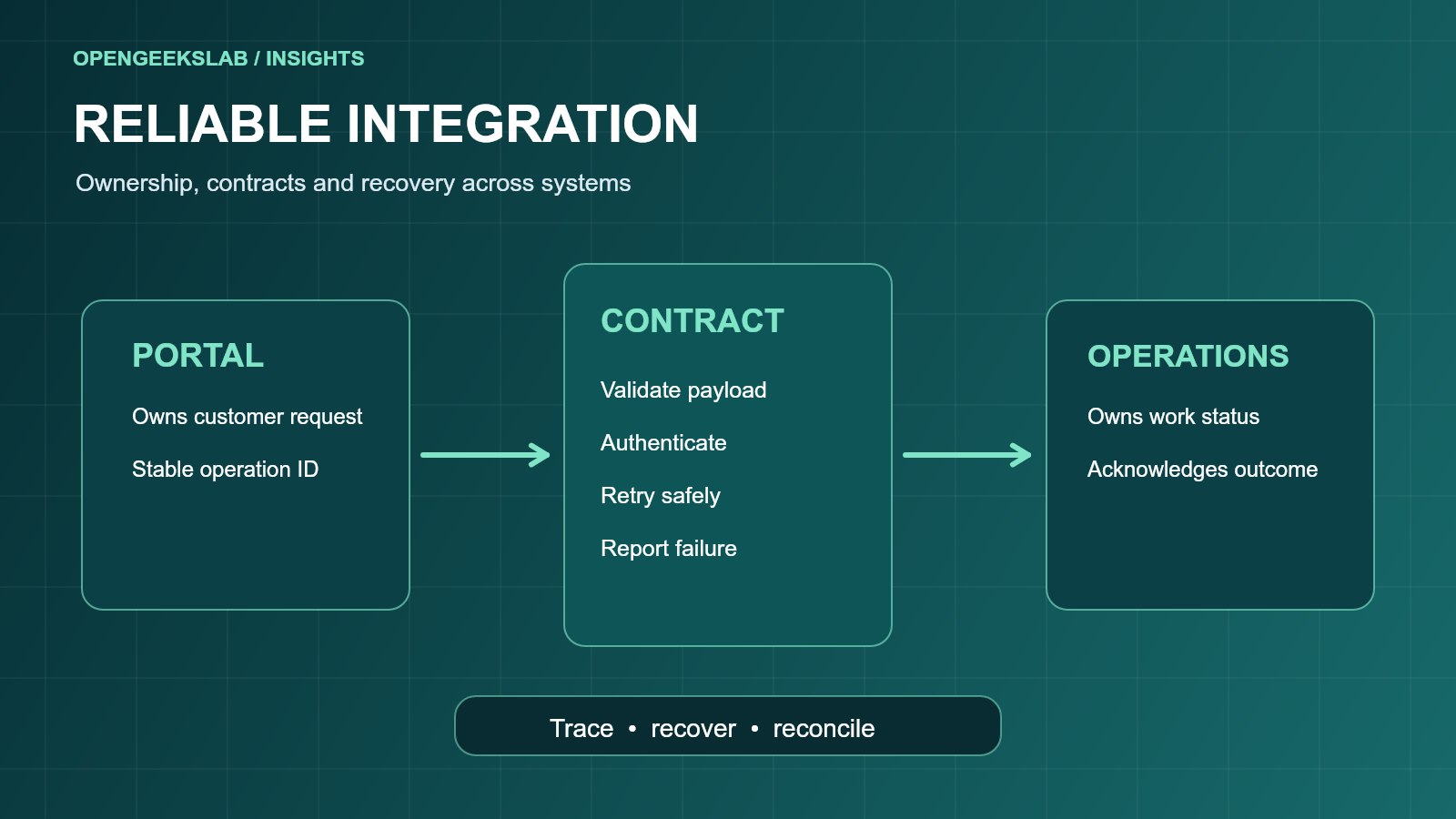
Direct answer: Reliable API integration starts with a clear owner for each record and a contract for how changes cross system boundaries. Design for delays, retries and partial failures before connecting the first production workflow.
OpenGeeksLab can help through custom software development. Read our related practical guide for a connected view of the delivery process.
Map systems of record
Identify which application owns each entity, such as customer, order or service request. List the events that should move between systems and the fields required at each step. If two tools can edit the same field, define conflict resolution before implementation.
Choose the interaction pattern
Use a synchronous request when the caller needs an immediate answer. Use asynchronous events when the process can continue despite delay and consumers can handle messages later. The Microsoft event-driven architecture guide explains the tradeoffs of event-based integration. Select a pattern based on business timing and recovery needs, not on fashion.
Make retries safe
Assume a request or event may be delivered more than once. Give each business operation a stable identifier and make handlers recognize completed work. Return actionable errors and keep failed messages visible to operators. Test the cases where one system succeeds and the other times out.
Protect and observe data flows
Authenticate each connection, grant the least necessary scope and encrypt traffic. Avoid logging full customer payloads. Record correlation IDs, outcomes and latency so an operator can trace one transaction across services. The NIST Secure Software Development Framework gives development practices that apply to integration code.
Test with representative operations
Use real workflow examples in a controlled environment, including duplicate events, invalid payloads, service downtime and a schema change. Confirm that staff can correct failures without manually re-entering data in several tools. Document who owns each interface and how a change is released.
Work through one transaction end to end
Consider a service request created in a customer portal and routed into an operations system. Decide which system owns the request ID and status. Specify what the portal should show while the operations system is unavailable. When the update is retried, use the same operation key so it cannot create a second request. Give support staff a traceable reference rather than forcing them to compare records manually.
Define the integration contract
For each interface, write down the trigger, request or event schema, version, authentication method, expected response, timeout, retry policy and error owner. Include examples of a valid payload and a rejected one. Decide whether consumers can tolerate a delayed update. An event is useful when several systems must react independently; a direct request is often easier when a user needs an immediate answer.
Plan for change and recovery
A supplier may add a field, retire an endpoint or change rate limits. Test compatible changes and failure recovery in a controlled environment before rollout. Monitor failed deliveries and provide a replay or correction path with an audit trail. Agree on who can restart a failed flow and how duplicate effects are prevented. This is a business continuity decision as much as an engineering detail.
Frequently asked questions
Do all integrations need an event bus?
No. A direct API call is simpler when the caller needs an immediate result and the dependency is acceptable.
What makes an integration maintainable?
Clear ownership, stable contracts, idempotent retries, visible failures and a documented change process.
Next step
Bring the two systems, a real transaction and its failure cases to our custom software team. We can map an integration contract and a small validation slice before implementation.