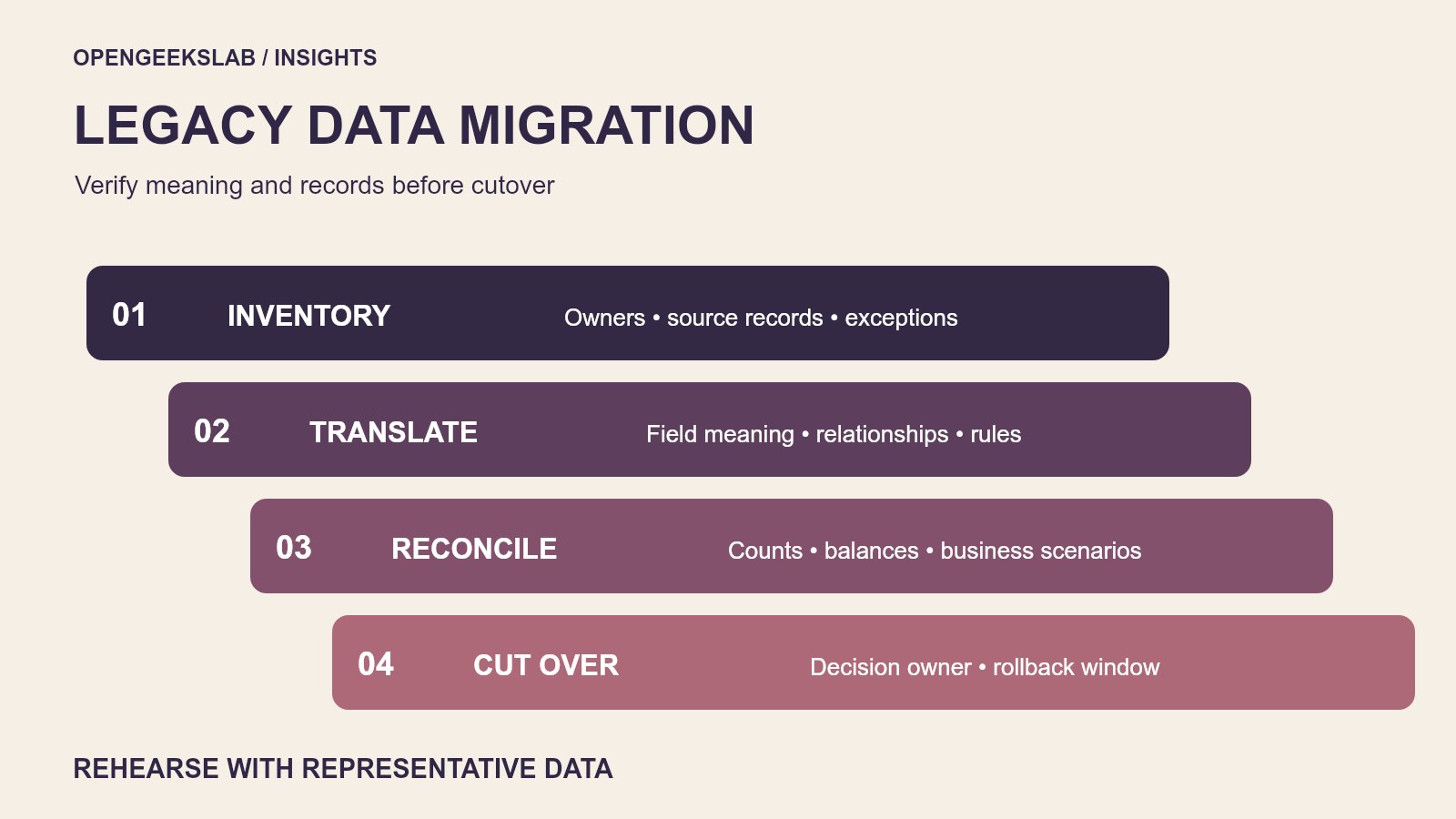
Direct answer: Migrate legacy data by defining the authoritative record, mapping fields and business rules, rehearsing with representative data, and planning a reversible cutover. The goal is continuity of the business process, not simply moving rows into a new database.
A modernization project often has two systems running at once. Sales, finance and operations still need reliable records while the new workflow is introduced. OpenGeeksLab’s software modernization service supports this transition; our incremental modernization guide explains why a staged migration can reduce change risk.
Inventory records and owners
List entities such as customers, contracts, products, transactions and audit events. For each, name the system of record, business owner, retention need and downstream users. Record how records are created, changed and deleted. A field with the same name in two systems may have a different meaning, so ask the people who use it before approving a mapping.
Profile a sample that includes old records, missing values, duplicate identifiers, unusual characters and historical exceptions. Decide whether to correct those issues before migration, carry them with a documented rule, or leave them in a read-only archive. Do not hide unresolved data quality behind a transformation script.
Map meaning, not only columns
Create a mapping table with source field, target field, transformation, validation rule and owner. Define identifiers and relationships before moving dependent records. If the old system encodes a status as a short code, write down the business meaning and target state. Include currency, time zone, consent and deletion semantics where applicable.
An anti-corruption layer can translate between old and new domain models while the systems coexist. That boundary helps keep legacy concepts from shaping every new screen and API. Treat it as a temporary, owned component with monitoring and a retirement plan.
Rehearse the cutover
Run at least one migration against a safe copy of representative data. Compare record counts, totals and relationships, then inspect business scenarios rather than relying only on aggregate counts. Can a customer support worker find the complete history? Can finance reconcile an open balance? Can an approved user still see the right account and no other account?
Measure migration duration and the period during which records could change in the old system. Choose a freeze window, change capture or dual-write strategy only after understanding that period. Dual writes add reconciliation complexity; a short controlled freeze may be safer for some workflows. Decide who declares the new system authoritative and what evidence they need.
Plan rollback and the coexistence period
Write down the point after which rollback becomes difficult, such as the first new transaction accepted only by the target system. Before that point, preserve backups and a tested reversal path. After it, a forward fix or controlled reconciliation may be more realistic. Define both options in advance and assign the decision owner.
The Strangler Fig pattern describes gradually replacing parts of a system while routing work between old and new implementations. Apply that idea to data ownership too: migrate one bounded workflow, verify it, then retire the old path. Keep monitoring for missing records, mismatched totals and delayed integrations throughout the overlap.
Practical acceptance checklist
- Every critical data set has an owner and mapping rule.
- Exceptional and historical records were tested.
- Business users verified real scenarios and permissions.
- Reconciliation and rollback decisions are documented.
- The old system has a defined read-only or retirement path.
A useful first workshop brings together the data owner, operational users and engineering lead. It produces a migration boundary and acceptance evidence rather than a promise that every record will move flawlessly.
Frequently asked questions
Should every historical record move into the new system?
No. Decide based on legal retention, user tasks, reporting and migration cost. A searchable read-only archive may serve some history better than forcing it into a new operational model.
When can the old system be switched off?
After the new workflow, reconciliation, permissions and retention requirements pass agreed checks, and the business owner accepts the cutover.