Direct answer: Legacy system modernization works best when you identify the business capability that is limiting change, define a safe boundary around it, and move that capability in measured stages. Keep the existing system running while the replacement proves its value. A full rewrite is justified only when the dependency map, data migration plan and business case show that a staged approach cannot meet the goal.
A system can be valuable and difficult to change at the same time. For a Swedish company, the friction might appear as slow changes to a customer portal, a finance workflow that depends on manual exports, or an integration that breaks whenever a supplier changes its API. The decision is rarely simply whether the code is old. It is whether the current architecture still lets the business deliver reliable changes at an acceptable cost and risk.
This guide gives founders, CTOs and IT managers a way to decide what to modernize first, how to protect daily operations, and what evidence to require before switching traffic. It treats modernization as a sequence of business decisions, not a technology purchase.
What is legacy system modernization?
Legacy system modernization is the deliberate improvement or replacement of existing software so it can meet current business needs. The work may involve code, interfaces, data, infrastructure, deployment, observability or the way teams own the system. Moving an unchanged application to a new server can improve an operational constraint, but it does not automatically resolve tightly coupled code or a difficult workflow.
The right scope depends on the problem. If releases are slow because tests are unreliable, start with release confidence. If a sales team re-enters data between two applications, examine the integration and data ownership. If customers cannot complete a critical task, focus on that journey. The target is a measurable improvement in delivery or operation, not a fashionable architecture diagram.
Start with the business constraint
Before choosing a framework or cloud platform, write down the business event that triggers the discussion. Useful examples are a delayed product launch, an increasing support queue, a change request that takes too long, or an important integration that has no clear owner. Pair each event with a baseline: lead time for a small change, failure frequency, recovery time, manual handling time, or the number of systems needed to complete a task.
Then ask what must remain stable during the work. For many Swedish B2B teams, that means preserving contract commitments, financial reporting periods, customer access, data handling rules and partner integrations. Those are planning inputs. They determine migration windows, acceptance tests and rollback decisions.
A compact discovery checklist
- Capabilities: Which workflows create value, and which ones regularly block changes?
- Dependencies: Which applications, vendors, databases, batch jobs and users depend on each workflow?
- Data: Who owns each record, where is it changed, and what consistency is required during migration?
- Operations: How are releases, incidents, backups, access and monitoring handled today?
- Economics: What is the cost of keeping the current capability, and what improvement would justify an investment?
Microsoft’s workload assessment guidance stresses dependency, code and database assessment before migration. The same principle applies even when the destination is not Azure: map what could break before deciding what to move.
Choose the smallest valuable slice
A good first slice is important enough to matter, bounded enough to test, and connected to a business result the team can observe. It may be an invoice approval step, a customer-facing status view, or an API that exposes product availability. Avoid beginning with the most entangled part of the system simply because it is the most painful. A short, contained slice can establish a safe delivery path before the hardest migration begins.
Score candidate slices on four questions: Is there a clear owner? Can inputs and outputs be described? Can the new behavior be compared with the current behavior? Can traffic or responsibility move back if needed? A slice with no rollback path or unknown data ownership needs more discovery before delivery.
Consider a hypothetical Swedish distributor whose sales staff copy order data from a legacy system into a customer portal. The first slice could expose order status through a controlled interface while the original system remains the source of record. Once data accuracy and support workflows are proven, further order capabilities can move. This is an example of sequencing, not a claim about a client project.
Use an incremental architecture when the boundary is clear
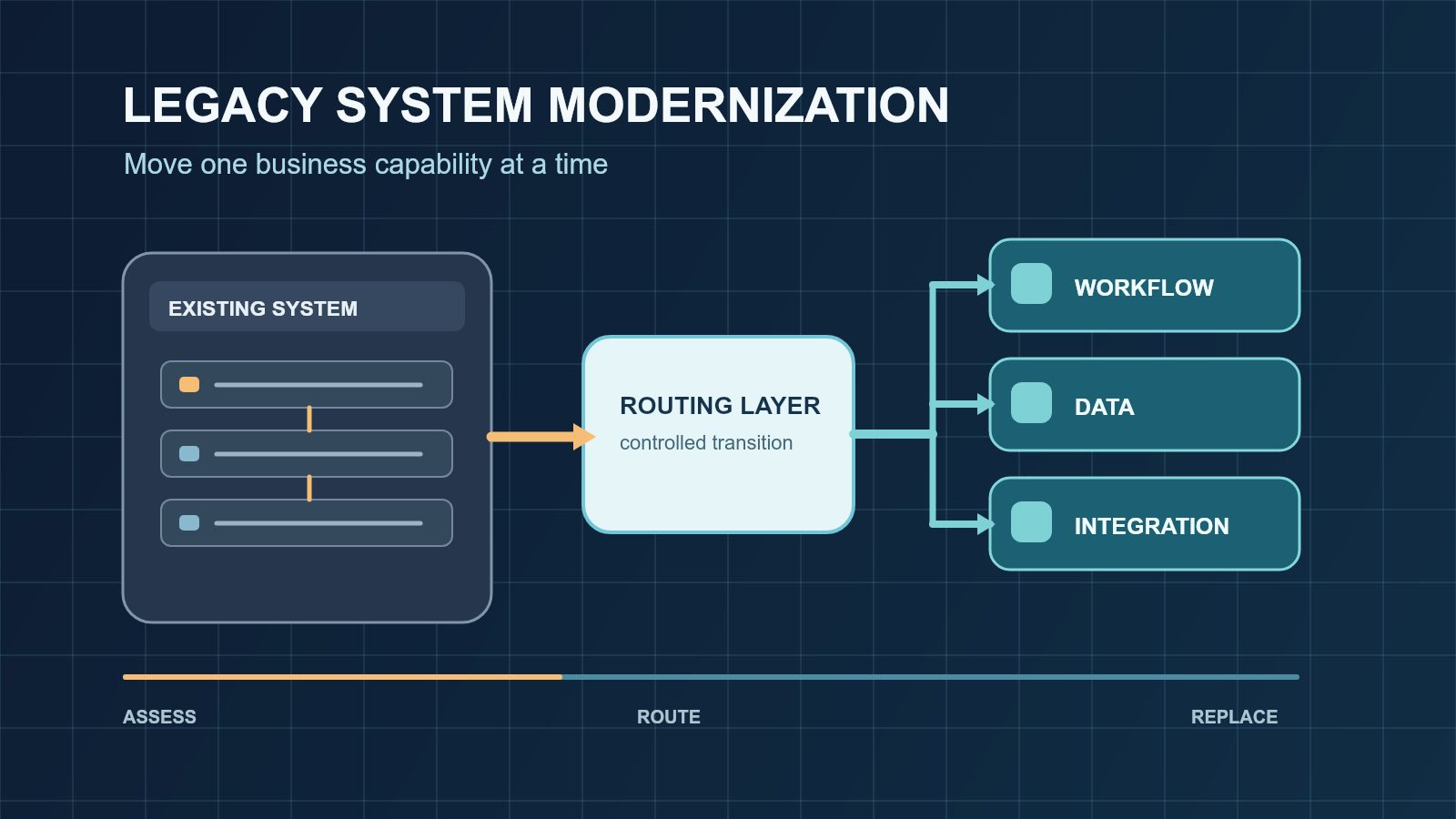
One established approach is the Strangler Fig pattern: place a routing layer in front of the existing application, then send selected functions to new components as each one becomes ready. Martin Fowler’s description sets out the gradual replacement idea; Microsoft’s architecture guide describes routing, coexistence and eventual retirement of the old component.
The diagram above illustrates the principle. It does not mean every system needs microservices. A modular application, a well-defined API or a revised data flow may be simpler to operate. The purpose of the boundary is to let a team change one capability without forcing every consumer to change at once.
What the routing layer must handle
- Stable entry points: Users and integrations need a consistent way to reach the capability during transition.
- Clear ownership: One system should be authoritative for each write at each stage.
- Observable behavior: Error rates, latency, business outcomes and data differences must be visible.
- Reversal: The team needs a tested way to return a slice to the previous path if acceptance criteria fail.
Routing is only part of the work. The hard decisions often concern identity, data synchronization, reporting and teams that still need the old application. Write those decisions down before a cutover, with the owner of each decision named.
Modernize data with the workflow, not after it
A new interface can look complete while its data remains unreliable. For each slice, document the source of truth, expected freshness, validation rules and how discrepancies will be resolved. If both systems can write the same field, specify conflict handling rather than assuming it will be obvious later.
Plan migration as a sequence of rehearsable operations: extract a representative data set, clean or map it, test the transfer, compare records, switch a limited cohort, and keep a recovery path. Sensitive production data should not be copied casually into development environments. Where personal data is involved, include privacy and access requirements in the acceptance criteria from the beginning.
For reporting workflows, also check period boundaries and historical comparability. If an updated calculation changes a financial field, business owners need to know whether the change is a correction, a new definition or a migration defect. A technical success that breaks a trusted report is not a successful release.
Decide between repair, replacement and rebuild
Not every legacy system should be replaced. A focused repair can be the best investment when the core model remains sound and the pain sits in tests, deployment or one integration. A staged replacement fits when valuable workflows can be separated while customers continue to use the current product. A full rebuild can be appropriate when the current architecture cannot support required behavior and the organization can fund parallel operation, data migration and extended acceptance testing.
Use a decision record for each major capability. State the business problem, options considered, expected benefit, dependencies, cost range, evidence still missing, and trigger for revisiting the decision. This makes the plan reviewable by product, finance and operations leaders as well as engineers.
Questions that expose a risky full rewrite
- Can the team enumerate the behavior users actually rely on, including exceptions and manual workarounds?
- Is there a way to compare the replacement with the current system on real workflows before switching everyone?
- Who owns migration of data and external integrations, and how will they verify it?
- What will happen if the new system is late while the old one still needs maintenance?
If those answers are weak, reduce the first commitment to discovery and one bounded slice. The goal is to create evidence before increasing the investment.
Plan a 90-day first phase around proof
A practical first phase has three parts, with duration adjusted to the system and team. First, map capabilities, dependencies, data and a small set of baseline measures. Second, build the delivery path: automated checks, a bounded interface, monitoring and rollback. Third, migrate one selected workflow for a limited audience and compare it with the old path. The end of the phase should produce a decision: continue, change the approach or stop.
Define acceptance criteria before work starts. For example, a customer status view might need correct status for a defined test set, no increase in support cases, a measured response-time target and a successful rollback rehearsal. The exact thresholds belong to the business and technical owners. Do not copy an arbitrary benchmark into a plan.
Budget for parallel operation. During an incremental migration, the team supports old and new paths together. That is a real delivery cost, but it buys room to compare outcomes before retiring the old path. The retirement plan should name the final users, integrations and reports that must leave the old component.
What a relevant OpenGeeksLab project shows
OpenGeeksLab’s Financial Statement Software case study describes responsive financial reporting software for company validation, statements, schedules and data export. The project illustrates why a modernization discussion should include the complete reporting workflow, not only the user interface: validation, output and data movement all affect whether a new experience is usable for finance teams.
For a different organization, the right first slice could be a reporting view, an export path or the integration feeding the report. The choice follows from its actual dependencies and business priority. A useful partner should be able to explain the boundary and the acceptance evidence before recommending a particular stack.
Frequently asked questions
Do we need to move to the cloud to modernize a legacy system?
No. Hosting is one possible constraint. The improvement may instead come from clearer module boundaries, safer releases, better data contracts or a simpler workflow. Assess the actual bottleneck before choosing a hosting move.
Can we modernize while the current system stays live?
Often, yes. A staged approach lets the old system keep handling unmigrated capabilities while selected functions move behind a stable interface. It requires explicit ownership, monitoring and rollback plans; running two paths without these controls creates confusion.
When is a full rewrite the right choice?
Consider it when essential behavior cannot be separated safely and a comparable replacement can be specified, funded and validated. The decision still needs a data migration plan, a period of parallel support and a clear cutover criterion.
What should a modernization partner deliver first?
Expect a capability and dependency map, a prioritized first slice, target outcomes, the proposed boundary, data ownership, delivery risks and an acceptance plan. The first deliverable should make the next investment decision easier.
Make the next decision concrete
Legacy system modernization should give the business a safer way to change a valuable product. Begin with one constraint, one bounded capability and evidence that the new path works. If you are weighing a rewrite against incremental improvement, explore OpenGeeksLab’s Software Modernization service and bring us the current workflow, dependencies and decision deadline. We can help shape a technical assessment and a first delivery slice. For adjacent questions about building a scalable product, read our product development guide.