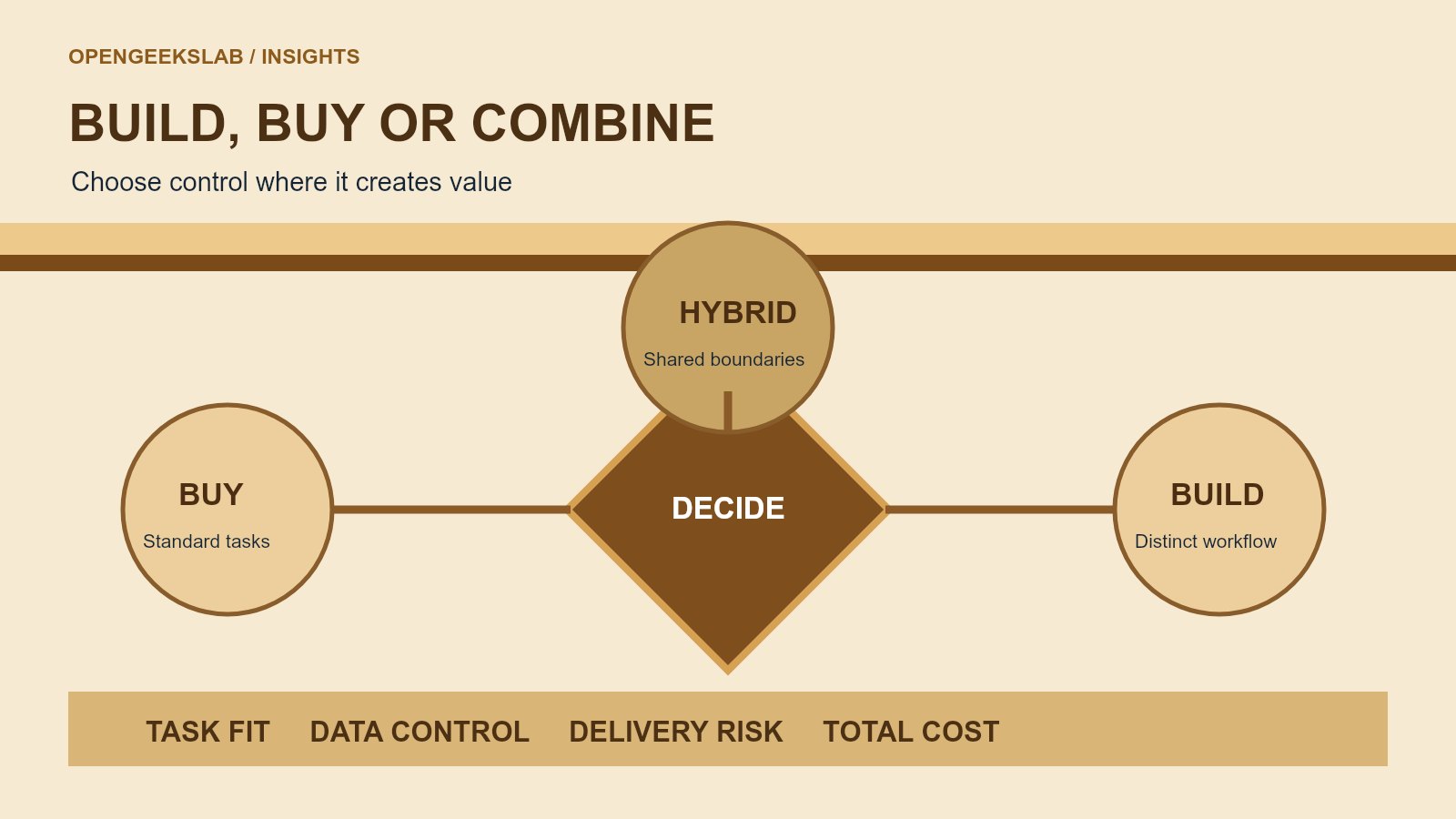
Direct answer: Buy standard capabilities when they fit the workflow and ownership cost; build the parts that require distinct control, integration or user experience. Many operational systems use both.
The build-versus-buy decision is rarely a choice between writing everything from scratch and accepting a rigid package. Most operational systems combine bought platforms, custom workflows and integrations. The useful question is where your organization needs control and where a standard product is sufficient.
Explore the implementation path through custom software development and our AI business process automation guide.
Map the workflow before comparing products
Describe the process from trigger to outcome, including exceptions, approvals, reporting and support. Mark the steps that make the organization distinctive and the steps that are routine. A vendor demonstration often follows the ideal path; evaluation should include the difficult cases that cause workarounds in real operations.
Test fit against real tasks
Give each option the same set of representative scenarios. Can staff complete the work without exporting data or rebuilding the process around the tool? Can the system handle permissions, audit trails, unusual cases and the volume expected? If a packaged tool covers the core journey with modest configuration, buying may reduce delivery time and maintenance burden. If the differentiating workflow demands extensive custom behavior, a custom layer or system may be more durable.
Include integration and data ownership
Check API limits, event access, export formats, identity integration and failure recovery. Ask where the authoritative record lives and how data will move if the product is replaced. The cost of a license can be small compared with years of manual reconciliation or a brittle integration.
Compare total cost and control
- Buying: Include subscription growth, implementation, configuration, vendor support, add-ons and exit costs.
- Building: Include discovery, design, engineering, security, infrastructure, testing, support and ongoing change.
- Hybrid: Include the boundaries between the package and custom components, plus ownership of each integration.
Security and supplier controls belong in the decision. The NIST Cybersecurity Framework helps organizations structure risk management, while the NIST Secure Software Development Framework provides practices relevant to software producers and purchasers. Apply the controls appropriate to the workflow rather than treating a checklist as a product decision.
Choose a reversible next step
Score options against the few criteria that matter most: task fit, integration, data control, risk, operating cost and ability to change. Run a limited proof with representative users and real exceptions. Document what would make the organization switch course. The strongest decision is one that supports the workflow now while preserving room to adapt.
Frequently asked questions
Can we combine bought and custom software?
Yes. A team can use a standard platform for common functions and build focused workflows or integrations where its operations need a better fit.
What cost belongs in the comparison?
Include implementation, integration, migration, licensing, maintenance, support and the cost of changing the system later.