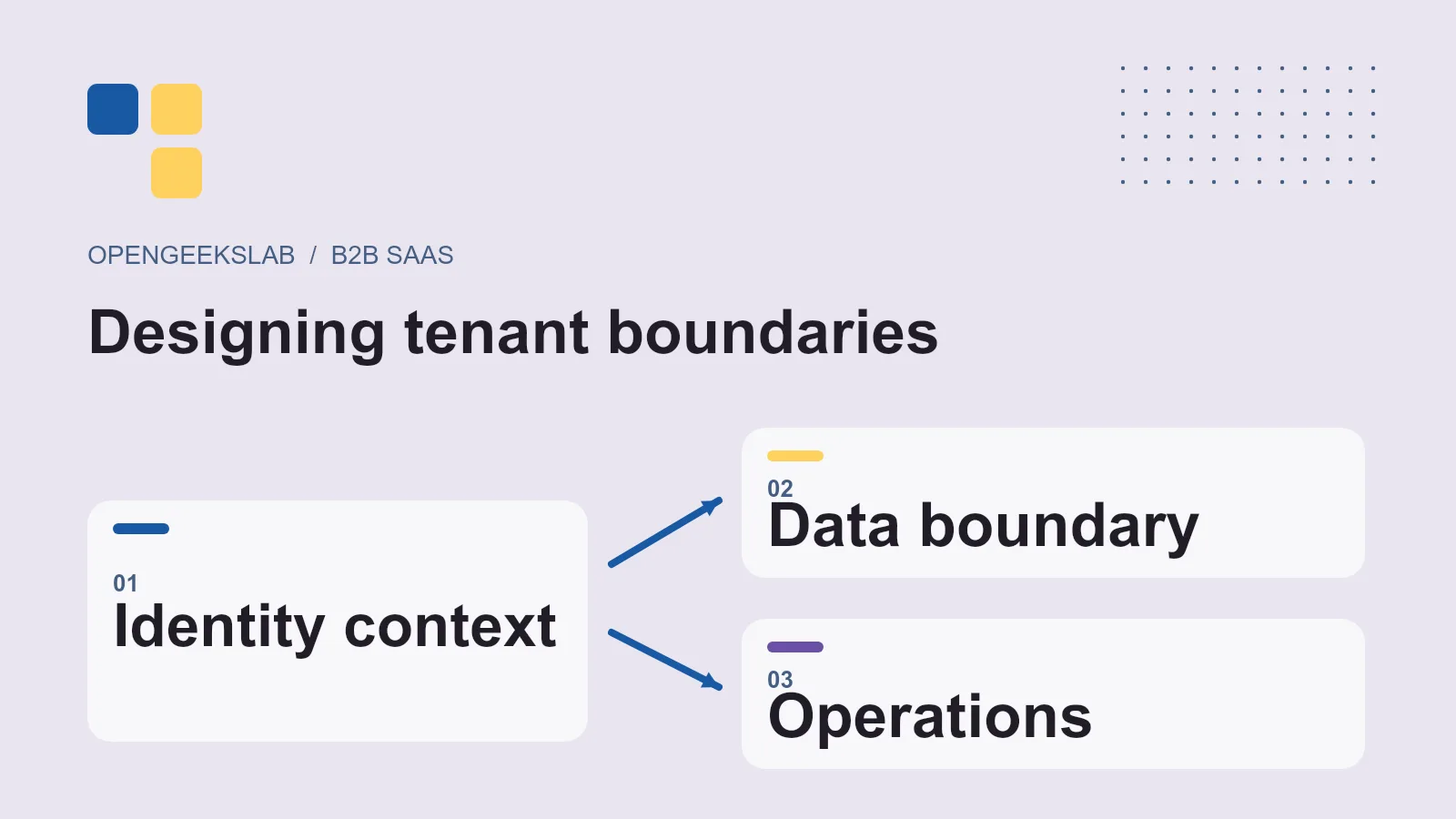
Direct answer: Tenant isolation means that one customer cannot read, change or disrupt another customer’s data or operations through a shared product. Review the boundary at every layer: identity, API authorization, database queries, files, background jobs, logs and support access. A tenant ID in a table is a starting point, not a complete security design.
A B2B SaaS team may begin with one customer and add others to the same application. The commercial advantage of shared software is clear, but every new customer increases the cost of an isolation mistake. Before enterprise sales or wider onboarding, turn isolation into a testable product requirement.
Choose the right isolation model
Microsoft’s multitenant architecture guidance describes isolation as a spectrum. A product may share application infrastructure while separating databases, or share a database with carefully enforced tenant boundaries. Different components may use different models. The choice depends on customer requirements, operational cost, performance and the consequences of a boundary failure.
For example, a shared database can simplify operations, but every query path must apply the correct tenant scope. A separate database can strengthen some data boundaries while increasing provisioning and maintenance work. Neither choice removes the need to secure authentication, files, queues and administrative access.
Trace one request end to end
Start with an ordinary action such as opening an invoice. Determine how the user is authenticated, how the active tenant is selected, and where authorization is checked. Never trust a tenant identifier merely because the browser supplied it. The server must confirm that the user belongs to the requested tenant and has permission for the specific resource.
Follow the request into caches, search indexes, object storage and exports. A correctly filtered database query does not help if a file URL, cache key or search query crosses the boundary. Apply the same review to background jobs and webhook handlers, where there may be no interactive user in the request.
Test isolation as a product behavior
Create two test tenants with similar records. Try to access the other tenant’s record by changing an object ID, file path, API parameter or job reference. Test read and write operations, not only the user interface. The OWASP API Security Top 10 identifies broken object-level authorization as a leading API risk; an automated cross-tenant test directly targets that failure mode.
Test support tools as well. An administrator should have a documented reason, scope and audit trail for access to customer data. Operational metrics should reveal failures by tenant without leaking another customer’s details into logs.
Decision checklist
- Where is tenant identity established and verified?
- Which services store or cache tenant data?
- Can a customer-supplied ID change the tenant context?
- Do files, exports, jobs and webhooks enforce the same boundary?
- How is privileged support access approved and recorded?
Our B2B portal MVP guide covers scope and access decisions for an initial release. OpenGeeksLab’s custom software development team can turn a tenant-boundary review into an implementation and test plan.
Frequently asked questions
Does a separate database guarantee isolation?
No. It narrows some data risks, but identity, routing, files, backups, jobs and support tooling still need explicit boundaries and tests.
When should a team test cross-tenant access?
Before onboarding a second customer, whenever a new data path is introduced, and as part of regression testing for authorization changes.