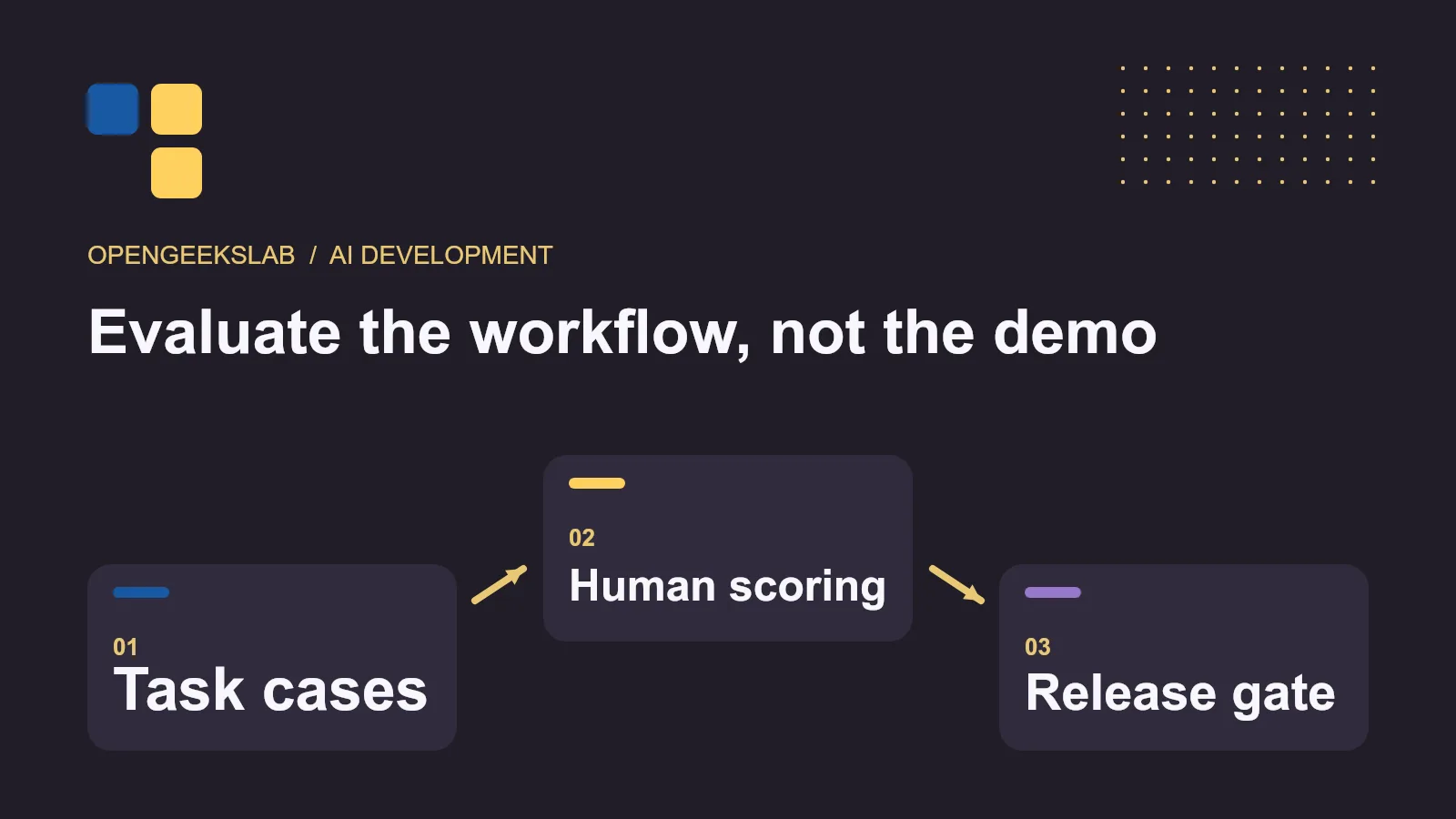
Direct answer: Build an AI evaluation set from the business tasks the system will actually handle. Include normal, difficult and unsafe cases; define the expected behavior for each; and score the complete workflow, including retrieval, permissions, human review and fallback. A convincing demo is not evidence that a system is ready for routine work.
For a support assistant, the question is not whether a model can write a fluent answer. The question is whether the workflow selects the right case information, respects access rules, avoids unsupported claims, sends consequential decisions to a person and recovers when a dependency fails.
Define the job and decision boundary
Choose one bounded workflow: classify incoming requests, draft a response, summarize a document or propose a next action. Write down who receives the output and what they may do with it. If the system only drafts text, the evaluator can focus on usefulness and correction effort. If it can change a record or send a message, authorization and approval become release-critical.
NIST’s AI Risk Management Framework organizes risk work around governance, mapping, measurement and management. Translate those functions into named owners, test cases, measures and a release decision for this specific workflow.
Build a representative case set
Collect examples from the real task distribution, remove unnecessary personal information, and label them by case type. Include ordinary cases, missing fields, conflicting documents, stale information, ambiguous requests, prompt-injection attempts and requests outside the system’s authority. Keep a holdout set for later changes so teams do not tune every revision to the same few examples.
Each case needs a reference outcome. That may be a correct answer, an acceptable range of answers, an escalation decision or a refusal. For a retrieval assistant, record which source material the user is allowed to see. An answer that is factually correct but cites another customer’s document is a failure.
Score useful behavior and failure cost
Use a short rubric with clear definitions: task completion, factual support, policy compliance, human correction time and escalation quality. A reviewer should be able to explain why a result passed or failed. Record failure severity separately from frequency. A rare cross-customer disclosure is more consequential than a minor wording issue.
OWASP’s LLM application risks include prompt injection and sensitive information disclosure. Include deliberate adversarial cases rather than assuming ordinary examples will expose these weaknesses. Re-run the set after changes to prompts, models, retrieval indexes, tools or permissions.
Turn evaluation into a release gate
Before expansion, compare the new workflow with the current manual process. Define who approves the pilot, which failures stop release, and how users report errors. In operation, monitor accepted, corrected, rejected and escalated outputs by case type. Keep a reversible path to manual handling.
- One named business task and owner.
- Representative and adversarial cases with expected outcomes.
- A scoring rubric linked to user and business impact.
- Permission and approval checks for every action.
- A documented pilot, rollback and monitoring plan.
See our RAG evaluation guide for retrieval-specific controls. OpenGeeksLab’s AI development service can help turn a prototype into a measurable workflow.
Frequently asked questions
How many cases are enough?
There is no universal count. Cover each important task and failure type, then expand the set as new cases and incidents appear. A small representative set with explicit outcomes is more useful than a large unlabelled collection.
Can a model grade its own output?
Automated grading can assist triage, but high-impact release decisions need a validated rubric and human review of representative failures.